On this page · 11 sections
Ask five web designers what a small business website costs and you will get five different numbers, sometimes ten times apart. That isn't because the industry is making it up. It's because "a website" covers everything from a one-page profile you build on a Sunday afternoon to a fifty-page lead machine with bookings, payments and a CRM behind it. This guide breaks the price into the parts you can actually control, shows the published ranges worth knowing, and helps you work out a sensible budget before you ask for a single quote.
The short answer, with a caveat
Prices vary a lot from country to country, so treat any published figures as a reference point rather than a price list. One well-maintained example is Startups.co.uk's cost guide for the UK market (last updated March 2026), which quotes prices in pounds sterling. It puts website builder plans at between £1.99 and £259 a month depending on features, a basic website from a web designer at around £300 to £1,000, and a custom or bespoke website at £10,000 or more. It also quotes hourly rates of roughly £25 to £50 for freelancers, £50 to £150 for small agencies and £75 to £200 or more for large ones.
Those figures describe one market. The same shape holds almost everywhere, even though the absolute numbers move with local labour costs, and Juvios quotes its own projects in US dollars. The caveat is that ranges this wide don't tell you what your site should cost. A site at the bottom of that range and one at the top are not the same product at different prices. They are different products. The useful question is which product your business needs, and what it will cost to run once it's live.
What you're actually paying for
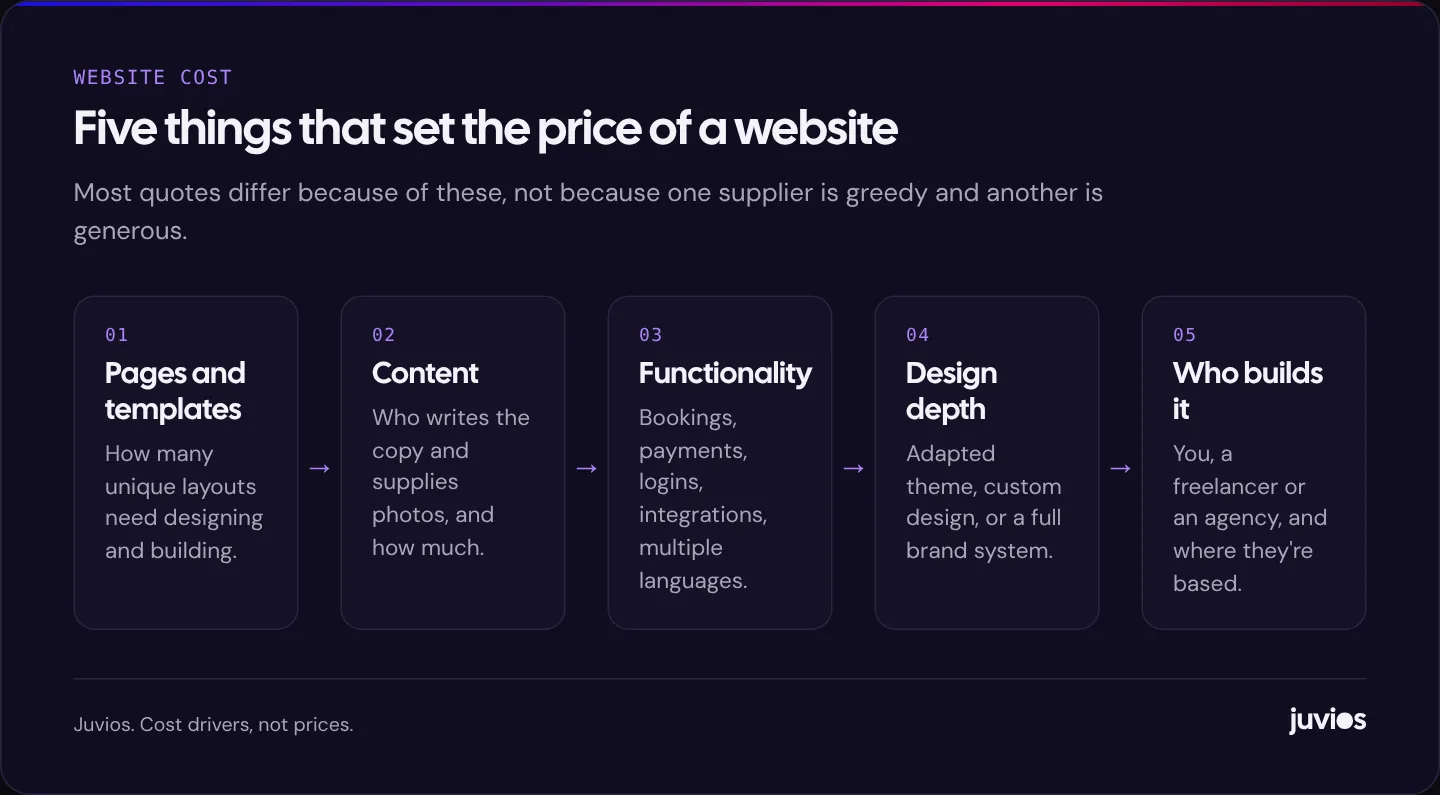
A quote that says "website: $X" hides a lot of separate jobs. When you see them listed, it gets much easier to compare suppliers and to decide what you can do yourself.
Planning and structure
Before anyone designs anything, someone needs to decide which pages exist, what each one is for, and how a visitor moves from "I've landed here" to "I'm getting in touch". On a five-page brochure site this might take a couple of hours. On a site with twenty service pages, several locations and an online booking flow, it can take days. Skipping it is the most common reason a new website looks good and still doesn't bring in enquiries.
Copy and images
Content is where budgets quietly go wrong. If you supply finished text and good photos, the build moves fast. If the agency writes the copy from scratch, interviews you, sources photography and edits everything, that is real work and it should be priced. Ask every supplier the same question: who is writing the words? The answer often explains most of the gap between two quotes.
Design
There's a spectrum here. At one end, a designer adapts a ready-made theme to your colours and logo. In the middle, they design your key page templates from scratch. At the far end, they build a full design system with components, type scales and rules that a team can use for years. Each step up costs more and lasts longer.
Development and integrations
Turning a design into a working site is quick on a builder platform and slower in custom code. What really adds hours is functionality: online payments, appointment booking, customer logins, multiple languages, product catalogues, or connections to tools such as a CRM or email platform. Each integration has to be built, tested and kept working.
Search and analytics set-up
A professional build should include the basics: sensible page titles and descriptions, a sitemap, clean URLs, fast-loading images and analytics that record enquiries. If you're replacing an old site, it should also include redirects from the old URLs so you don't lose the rankings you already have. We explain that process in how to redesign a website without losing Google rankings.
 Tap to enlarge
The four ways to get a website built
Most small businesses end up choosing between four routes. None of them is wrong. Each one trades your money against your time and the result you need.
| Route | Best when | Watch out for | Your time |
|---|---|---|---|
| DIY website builder | You need something live quickly, the site is simple, and you're comfortable writing and editing it yourself. | Monthly fees that never stop, template limits, and the hours it takes to make it look right. | High |
| Freelancer | You have a clear brief, finished content and a modest budget, and the site doesn't need complex features. | One person is a single point of failure for support, updates and holidays. | Medium |
| Small or mid-sized agency | The website has to win enquiries, needs strategy and copy as well as design, and will be supported after launch. | Fixed-scope quotes. Check what's included, especially content, revisions and post-launch help. | Low to medium |
| Custom build | You need features or performance a theme or builder can't deliver, or the site is central to how you sell. | Higher cost, and you depend on developers for changes unless a proper CMS is included. | Low |
A common middle path is a professionally built site on a mainstream platform such as WordPress, Webflow or Shopify. You get a proper design and build, and you can still edit pages yourself afterwards. If you're weighing that against fully custom code, we compare the two in WordPress vs a custom-built website. For online shops, the equivalent decision is Shopify or WooCommerce.
The running costs people forget
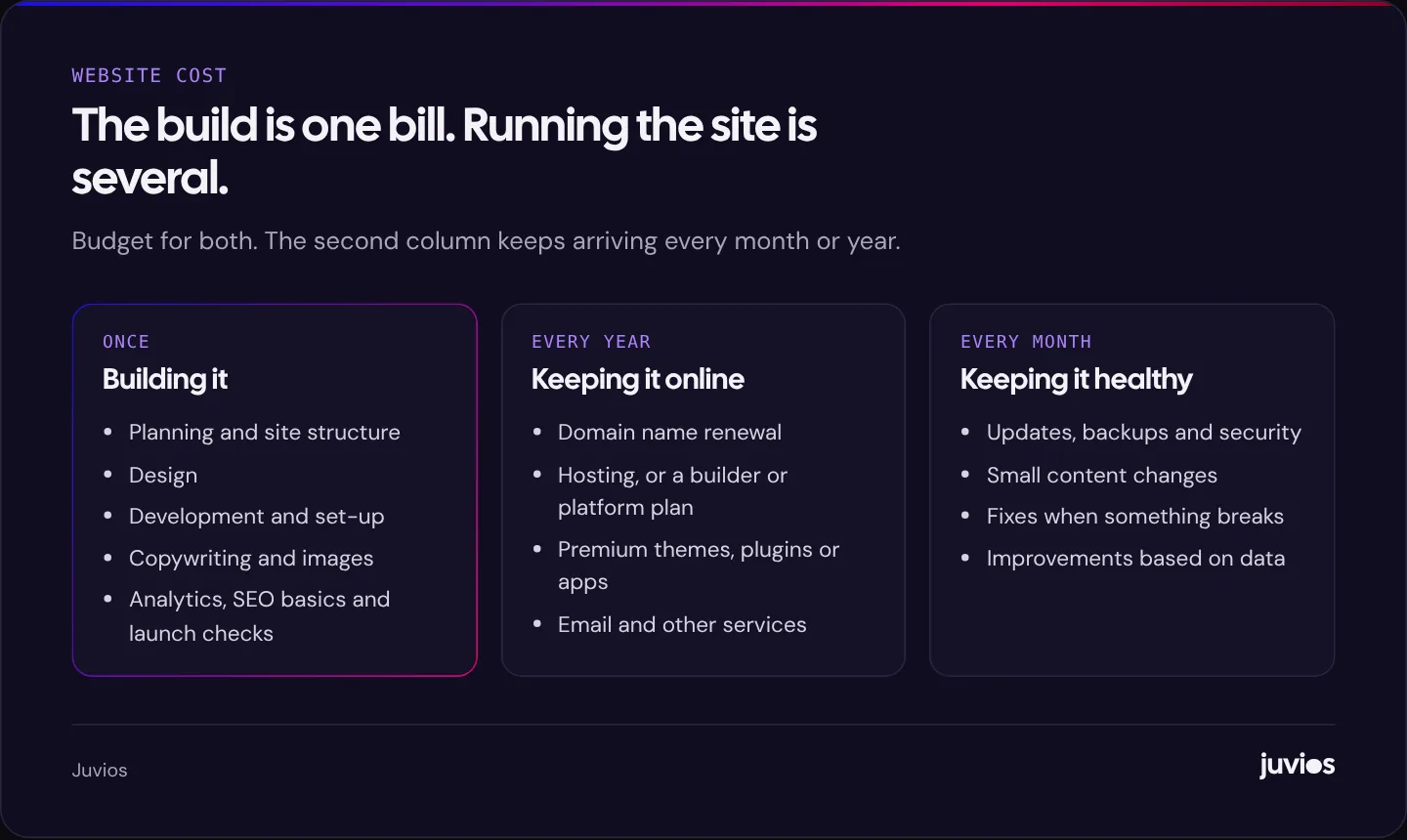
The build is a one-off. Owning a website is not. The bills that arrive after launch are smaller, but they never stop, so they belong in the budget from day one.
- Domain name. Renewed every year. Cheap for most endings, but let it lapse and someone else can buy it.
- Hosting or platform fees. Either web hosting for a WordPress or custom site, or a monthly plan for a builder or Shopify. Prices vary widely with traffic, support and performance.
- Premium themes, plugins and apps. Many are licensed yearly. A WordPress site with a page builder, a forms plugin, an SEO plugin and a backup tool can carry several renewals.
- Maintenance. Software updates, security patches, backups and uptime checks. Someone has to do this, and if no one does, the site slowly becomes a risk.
- Changes and improvements. New pages, updated prices, a seasonal offer, a fix after a browser update. Small, but frequent.
Platform pricing changes often, so check current figures on the vendor's own pricing page rather than trusting a blog post, including this one. What matters for planning is the pattern: a builder rolls hosting, security and updates into one monthly fee, while a self-hosted site splits them into separate costs that you or your agency manage.
 Tap to enlarge
How the type of site changes the cost
It helps to place your project in one of a few broad types before you talk to anyone. The type sets the baseline effort far more than the industry you're in.
A brochure site
Five to ten pages that explain who you are, what you do and how to get in touch. The work is mostly content and design. This is where a builder or a theme-based build makes the most sense, and where your own writing can save the most money.
A lead generation site
A site whose job is to bring in enquiries, usually with a page for each service and sometimes for each location. It needs more planning, more copy and proper tracking, because every page is meant to rank in search or to receive ad traffic. Expect more hours in structure and content than in design.
A booking or membership site
Anything where customers log in, pay a deposit or book a time slot. The integrations and testing add cost, and so does the extra care needed around personal data and payments.
An online shop
Product pages, a catalogue, a checkout, shipping rules, taxes and stock all add work. The number of products matters less than how they're organised and how much of the content has to be written or imported. Platform fees and payment processing also become a running cost.
What a very low or very high quote is telling you
A quote that's far below the others usually means one of three things. The supplier is using a template with minimal changes, they're assuming you'll write and load all the content, or they haven't understood the scope. None of these is a scam, but you should know which one you're buying. Ask them to list exactly which pages, which features and how many rounds of changes are included.
A quote that's far above the others may include work the cheaper quotes left out: copywriting, photography, a content migration from your old site, accessibility testing, or a year of support. Or it may reflect a larger team and more process than your project needs. Again, the answer is in the line items, not the total.
Questions to ask every supplier
- Who writes the copy, and how many pages of it are included?
- Which platform will you build on, and why that one for us?
- Will I be able to edit text, images and pages myself without calling you?
- What happens to my current URLs and rankings when the new site goes live?
- What does hosting, maintenance and support cost after launch, and what does it cover?
- Who owns the domain, the hosting account, the design files and the code?
That last question matters more than people expect. Your business should own its domain and have admin access to its hosting and website. If a relationship ends, you should be able to take the site with you.
How to set a realistic budget
Start from what the website has to do, not from a number you've heard. A site that exists so people can check you're real has very different requirements from a site that has to generate most of your new business.
Work out what an enquiry is worth
If a typical new customer is worth a few hundred pounds over their lifetime, a modest website that brings in a handful of extra enquiries a month pays for itself. If a customer is worth tens of thousands, a site that converts slightly better is worth a much larger investment. You don't need precise figures. A rough sense of customer value keeps the budget conversation grounded.
Decide what you'll do yourself
Writing your own copy, supplying your own photos and loading content are the biggest levers on cost. They are also the tasks most often done badly. Be honest about your time and your writing. A strong professional page often outperforms a weak page written for free.
Budget for year one, not launch day
Add the build cost, the annual running costs and a small allowance for improvements. Most sites need adjustments in the first few months once you can see how people use them. A site that's launched and then left alone rarely gets better.
Spending on what actually brings in work
Whatever you spend, put the money where it changes results. For most small businesses that means clear service pages that answer the questions customers ask, fast load times on mobile, obvious ways to get in touch, and tracking that tells you which pages produce enquiries. A beautiful animation on the home page rarely moves the numbers. A clearer headline and a shorter enquiry form often do. If you already have a site and it isn't working, read why your website isn't generating leads before you replace it, because the fix may be smaller than a rebuild.
Speed is one of the places where cheap builds often cut corners. Oversized images, heavy themes and too many plugins all slow a site down. Google measures real-world loading and responsiveness through Core Web Vitals, and our guide to improving Core Web Vitals explains what good looks like.
Finally, think about the site as part of your marketing, not a one-off purchase. A website that's built with search in mind gives SEO something to work with, and a site with clear landing pages makes every pound of Google Ads spend go further.
Putting it together
There's no single price for a small business website, but there is a sensible process for finding yours. Decide what the site needs to achieve. List the pages, content and features that follows from that. Choose the build route that fits your time and budget. Then compare quotes on scope, ownership and running costs, not just the headline figure.
Do that and you'll avoid the two expensive mistakes: paying for a site that's far more than you need, and paying twice because the cheap one didn't work. If you'd like a second opinion on a quote or a scope, book a free consultation and we'll talk it through.
Common questions
01Is it cheaper to build my own website?
In cash, usually yes. In time, rarely. A website builder lowers the upfront cost, but you pay a monthly fee and do the writing, design and set-up yourself. For a simple site that's a reasonable trade. For a site that has to win business, a professional build often pays for itself.
02How long does a small business website take to build?
It depends on scope and how quickly content and feedback arrive. Our website projects typically take 4 to 8 weeks from kickoff to launch. A simple builder site can be live in days; a large custom build can take months.
03Do I have to pay every month for a website?
You'll always have some ongoing costs, such as the domain and hosting or a platform plan. Maintenance and support are optional but strongly recommended, because unmaintained software becomes a security risk.
04Should I own my domain and hosting?
Yes. Register the domain in your business's name and keep admin access to the hosting and website. Your agency can manage them, but you should never be locked out of your own site.
Sources
- How Much Does a Website Cost? (updated 23 March 2026) Startups.co.uk
- Understanding Core Web Vitals and Google search results Google Search Central
- Creating helpful, reliable, people-first content Google Search Central