On this page · 12 sections
If you have a limited marketing budget and you want more enquiries from Google, you'll quickly face a choice: pay for ads, or invest in SEO. Ads promise results this week. SEO promises results that last. Agencies that specialise in one tend to dismiss the other. The truth is that they work in different ways, on different timescales, and suit different situations. This guide explains how each one works, what each really costs, how long each takes, and how to decide where your first pound, rupee or dollar should go.
Two ways to appear on the same page
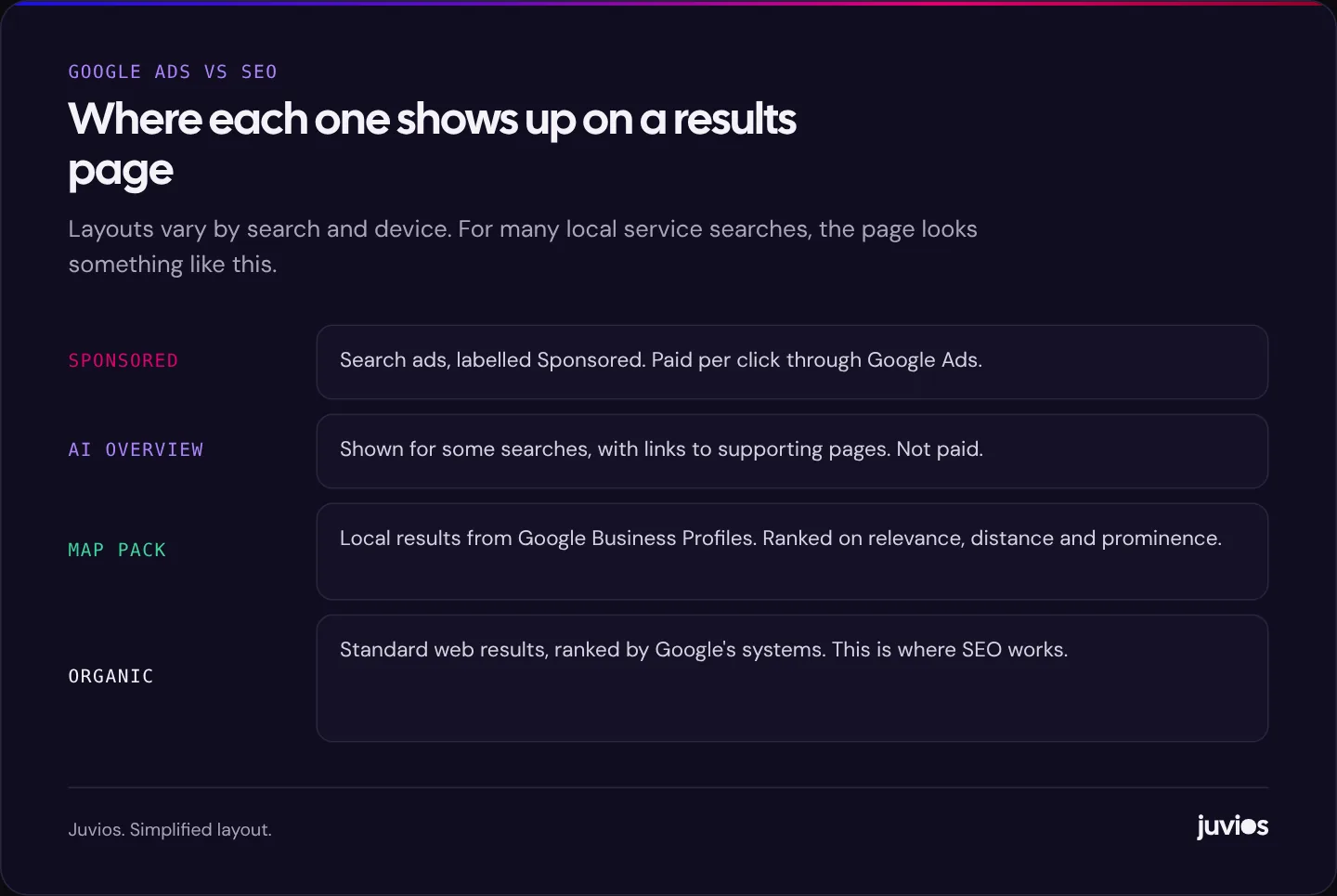
Google Ads and SEO both aim to put your business in front of people searching on Google, but they buy that visibility in completely different ways.
With Google Ads, you pay to appear in the sponsored positions. You choose the searches you want to show up for, write ads, set a budget and bid, and pay when someone clicks. Visibility starts as soon as campaigns are approved and stops the moment you stop paying.
With SEO, you earn your place in the unpaid results. Google ranks organic results using its own systems, and it states clearly in its explanation of how results are ranked that it doesn't accept payment to rank pages higher. SEO is the work of making your website the most relevant and useful result for the searches that matter to you, and of earning the reputation signals that help it rank.
 Tap to enlarge
For local searches there's a third area that matters a great deal: the map results, driven by your Google Business Profile. It's organic, so you can't pay to rank there, and it's often the most valuable placement for service businesses. We cover it in why your business isn't showing on Google Maps.
How quickly each one works
This is the biggest practical difference, and it usually drives the decision.
Google Ads
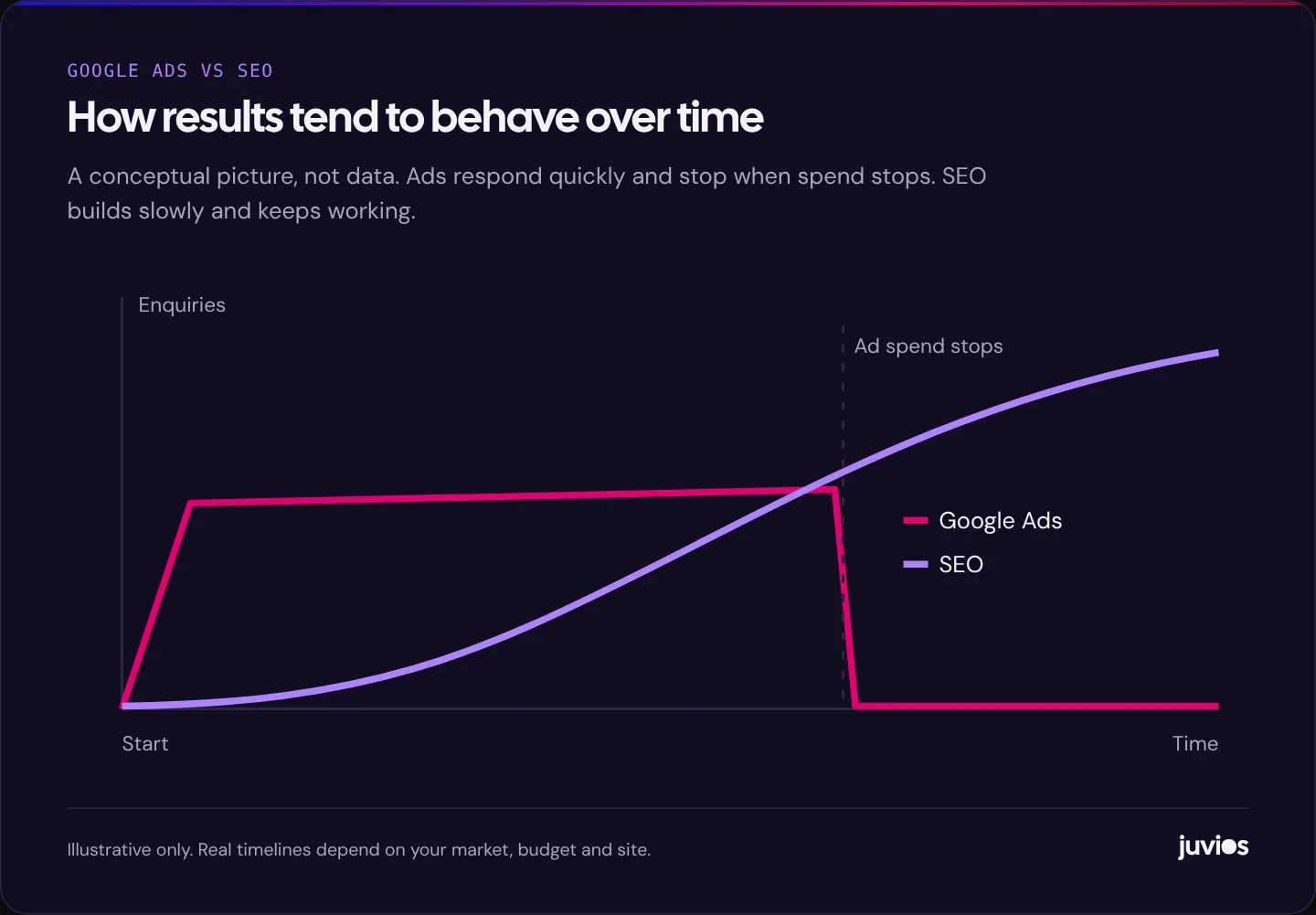
Ads can start bringing traffic within hours of approval. In our experience, search campaigns usually bring their first leads in the first one to two weeks, with the first month spent learning which keywords, ads and pages work. Costs per lead usually come down in the following months as the account is refined. If your business needs enquiries this month, ads are the only one of the two that can reliably deliver them.
SEO
SEO takes longer because you're waiting for Google to crawl, assess and rank improved pages, and because reputation builds gradually. In our experience, most businesses see meaningful growth after three to six months of steady work. Local SEO can move faster, especially when a Google Business Profile has obvious gaps. Competitive national searches take longer, sometimes much longer.
 Tap to enlarge
What each one really costs
Both cost money, and both cost more than the headline figure if you count everything.
The cost of Google Ads
You pay for clicks, and the price of a click depends on how many businesses bid for the same searches and on the quality of your ads and landing pages. Google uses Quality Score as a diagnostic of how relevant your ads, keywords and landing pages are compared with other advertisers, and more relevant ads tend to cost less per click. On top of ad spend, there's the cost of managing the account, whether that's your time or an agency's fee, plus landing pages and tracking.
Budgets vary enormously by industry and location. Most of our Google Ads clients start with between USD 500 and USD 3,000 a month in ad spend, but a niche local service may need less and a competitive legal or finance market much more. Our guide to lowering your Google Ads cost per lead covers the levers that matter most.
The cost of SEO
SEO has no per-click cost, but it isn't free. You pay for the work: technical fixes, content writing, page improvements, local SEO and earning links and mentions, whether you do it yourself or hire someone. It's typically a monthly investment over a long period, and the return arrives gradually rather than immediately.
The economics differ in one important way. With ads, every additional enquiry costs roughly the same as the last, and the cost stops when the ads stop, along with the enquiries. With SEO, the work you pay for now keeps producing enquiries long after it's done, as long as the pages stay relevant. Over a long horizon, that tends to make SEO cheaper per enquiry, but only if you can afford to wait.
Side by side
| Google Ads | SEO | |
|---|---|---|
| Where you appear | Sponsored positions | Organic results, map pack, AI Overviews |
| Speed | Days to weeks | Months, building over time |
| Cost model | Pay per click, plus management | Pay for the work, no cost per click |
| When you stop | Traffic stops straight away | Traffic declines slowly, if at all |
| Control | Precise control of searches, locations, times and budget | Less control; Google decides rankings |
| Testing | Fast: try new offers and messages in days | Slow: changes take weeks to show |
| Best for | Urgent demand, new offers, high-value searches, testing | Long-term growth, lowering acquisition cost, trust |
| Main risk | Wasted spend on poor targeting or weak pages | Slow returns and uncertain timelines |
When Google Ads should come first
- You need enquiries soon. A new business, a quiet period or a cash-flow gap can't wait months for SEO.
- Your website is new. A new domain has no ranking history, so ads bridge the gap while SEO builds.
- Each customer is valuable and searches are specific. Searches such as "emergency electrician near me" or "conveyancing solicitor quote" signal intent to buy, and paying for them can be very profitable.
- You want to test. Ads tell you within weeks which services, messages and offers attract enquiries. That knowledge makes later SEO work more focused.
- The organic results are dominated by directories or national brands, and ranking above them will take a long time.
When SEO should come first
- You can afford to wait, and you want lower acquisition costs over the long term.
- Clicks in your market are expensive and margins can't support paying for every visitor.
- Customers research before they buy, reading guides and comparisons. Content that answers their questions builds trust that ads can't.
- Your website already has some visibility that you can build on, such as pages ranking on page two or a Business Profile with untapped potential.
- You want to appear in AI answers. AI Overviews and other AI search tools draw on organic content; see how to get your business into AI search answers.
Using both together
For many small businesses, the right answer isn't one or the other but a sequence. Start with ads to bring in enquiries and learn what converts, while investing steadily in SEO. As organic visibility grows, reduce ad spend on the searches where you now rank well and keep ads for the most valuable or competitive searches.
The two channels also help each other. Search term reports from ads show exactly which phrases lead to enquiries, which is valuable for SEO. Landing pages built for ads can become strong organic pages. And appearing in both the sponsored and organic results for an important search can increase the share of clicks you get, though it's worth testing whether ads on searches where you already rank first organically are paying their way.
A simple way to split a small budget
There's no formula that fits every business, but a sensible starting point is to fund the urgent need first and the long-term need second. If you need leads now, put most of the budget into well-targeted ads on high-intent searches, with a smaller, consistent amount into SEO foundations such as your Business Profile and key service pages. If you can wait, reverse the balance and use a modest ad budget mainly to test and learn. Review the split every quarter using real enquiry data, not impressions or clicks.
Questions to ask before you hire anyone for either
Whether you're hiring an agency, a freelancer or a new team member, the right questions quickly separate people who'll be measured on your results from people who'll be measured on activity.
For Google Ads
- Will the account and its data be in my name, so I keep them if we part ways?
- How will you track enquiries, including calls, before campaigns go live?
- Which searches will you target first, and which will you exclude?
- How is your fee separate from my ad spend, and what does it cover each month?
- What will you change in the first month, and how will we judge whether it's working?
For SEO
- Which searches and pages will you focus on first, and why those?
- What will you actually do each month: technical fixes, content, local SEO, links?
- How will you report progress in terms of enquiries, not just rankings?
- How do you earn links and mentions, and can I see examples?
- What do you need from me, such as access, information and approvals, to make it work?
Be wary of guarantees. No one can promise a specific Google ranking, and anyone who guarantees the top spot is either redefining the term or taking a risk with your site.
Mistakes we see on both sides
Running ads to a weak website
Paying for clicks that land on a slow page with a vague headline and a long form is the fastest way to conclude that Google Ads doesn't work. It usually works fine; the page doesn't. Fix the landing page before you scale the budget.
Broad targeting on a small budget
Small budgets spread across broad keywords, wide locations and every hour of the day run out quickly on searches that were never going to convert. Concentrate a small budget on the most specific, highest-intent searches in the areas you serve, and expand once those are profitable.
Doing SEO without a target
SEO effort that isn't tied to specific searches and pages produces activity rather than results. Blog posts on loosely related topics, links from irrelevant sites and endless technical tinkering won't bring enquiries if your core service pages aren't strong. Start with the searches your customers use when they're ready to buy, and make the pages that answer them as good as they can be.
Judging SEO too early, or ads too late
Giving up on SEO after six weeks is as common as letting an unprofitable ad campaign run for a year. Set expectations at the start: a few weeks to judge whether ads can be profitable, and several months to judge whether SEO is moving in the right direction.
Treating them as rivals
Separate agencies for ads and SEO that never talk to each other miss the easiest wins: sharing converting keywords, aligning landing pages, and shifting spend as organic rankings improve. Whoever runs them, make sure the two plans are joined up.
Measure both on the same terms
The only fair way to compare the two is by enquiries and customers, not clicks or rankings. Set up conversion tracking so that every form submission, call and booking is recorded with its source. Our guide to Google Ads conversion tracking explains the set-up for ads, and the same key events in Google Analytics 4 let you see organic enquiries alongside paid ones.
Then compare cost per enquiry and, ideally, cost per customer for each channel over a sensible period. For ads, a month or two is enough to judge. For SEO, look at the trend over six to twelve months and remember that the work keeps paying after the invoice. Combine that with what you learn about lead quality from your sales conversations, and the right balance usually becomes clear.
If you're still unsure, we're happy to look at your market and your numbers with you. See our SEO and Google Ads services, or book a free consultation.
Common questions
01Does running Google Ads help my SEO?
Not directly. Google says organic rankings can't be bought, and ad spend doesn't affect them. Ads can help indirectly by showing which keywords convert and by bringing visitors who later search for your brand.
02Can I stop SEO once I rank well?
You can reduce it, but rankings can slip as competitors improve and search results change. Most businesses keep a lighter, ongoing level of SEO work to protect what they've built.
03Which is better for a local service business?
Often both, with local SEO first in line because the map results are so valuable. Ads fill gaps while your Business Profile and service pages build strength.
Sources
- How results are automatically generated Google Search
- About Quality Score for Search campaigns Google Ads Help
- Tips to improve your local ranking on Google Google Business Profile Help
- AI features and your website Google Search Central